Origins
Genesis of Litania Christi
The story behind the Litany of the Most Holy Mind of Our Lord Jesus Christ
The Invitation to Think as Christ Thinks
The origin of this spiritual initiative lies in a simple but profound recognition: that to follow Christ is not merely to imitate his external actions, but to share in His manner of perceiving and judging all reality. The Gospel calls us not only to act differently, but to think differently — to adopt the mind of Christ (cf. 1 Cor 2:16).
The litany grew out of sustained reflection on Matthew 16:23, where Jesus rebukes Peter with the words: "You do not think as God thinks, but as human beings do." This contrast — between divine thinking and merely human thinking — became the seed of the whole initiative. What does it mean to think as God thinks? What are the contours of Christ's mind?
The twenty-eight invocations trace an answer to this question, drawing on the Gospels, the Epistles, and the whole tradition of Christian spiritual theology. Each invocation is both a description of how Christ's mind operated and an aspiration — a prayer that our minds might be gradually conformed to His.
The Logo and Its Meaning
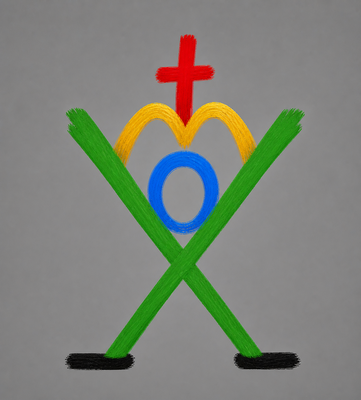
The cross at the center of the Litania Christi symbol is not simply the emblem of Christianity in general, but a specific reference to the transforming power of the Cross on human thought. The shape draws together the vertical — God's perspective, coming down to humanity — and the horizontal — the breadth of human solidarity and concern that flows from thinking as Christ thinks.
The golden color speaks of divine glory, the permanence and preciousness of the truths that Christ's mind reveals. The dark ground on which the symbol is set represents the darkness of merely human thinking — the darkness that the light of Christ's mind illuminates and gradually transforms.
Imprimatur
The Litany of the Most Holy Mind of Our Lord Jesus Christ has received the ecclesiastical approval of competent Church authority. The Imprimatur — Latin for "let it be printed" — signifies that the text has been examined and found free from errors concerning Catholic faith and morals, and is suitable for publication and use in prayer.
This approval represents the Church's confidence that the litany authentically reflects the Catholic tradition and may serve as a reliable guide for the interior life of the faithful. It is not a canonization of the work, but a judgment that it poses no danger to faith and may serve spiritual benefit.
For the specific details of the Imprimatur, including the bishop and date, please refer to the official Polish-language pages of this initiative, which contain the authoritative documentation.
The Biblical Foundation
The litany is deeply rooted in the New Testament witness to the mind and interior life of Jesus. The Gospels give us access not only to His words and deeds but to His motivations, His emotional responses, His manner of perceiving people and situations. From this rich portrait, the twenty-eight invocations are drawn.
The theological backbone of the initiative is the Pauline concept of the "mind of Christ" (nous Christou, 1 Cor 2:16) — the suggestion that participation in Christ involves not merely behavioral conformity but cognitive and affective transformation. To have the mind of Christ is to perceive reality as He perceived it, to value what He valued, to be moved by what moved Him.